Quench Time Verification
Relation: Ellwood Crankshaft Group
Role: Metallurgy Intern
Skills: CAD (SolidWorks), FEA (Ansys Mechanical), Fluid Mechanics, Heat Transfer, Etching, Impact Testing, Tensile Testing, Microstructural Analysis
Timeline: July 2026 - Aug 2026

Background:
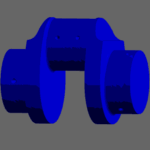
The current method of determining quench hold times for crankshafts relied heavily on an Excel database. The issue with that approach is that each crankshaft has unique geometry, so the targeted max temperature region can't be determined using only previous part and material data.
I was placed in charge of using FEA to simulate quench conditions and verify that process on a customer's crankshaft. If I'm able to achieve this, it will be utilized moving forward for all parts on the shop floor.
Direct Contributions:
● Created input templates for various materials including 1045, 4140, and 4340
● Designed boundary conditions to simulate quench hold times of customer crankshafts
● Conducted impact testing and tensile testing to verify that mechanical requirements are within allowable range
● Polished and etched samples for microscope analysis
● Performed microstructural analysis and verified full martensitic transformation at simulated depth
Outcomes:
Increased the accuracy of determining quench hold times on the shop floor. ECG will utilize this system moving forward.